
Do You Actually Need an RFID-Blocking Wallet? 8th October 2026 – Posted in: Wallets
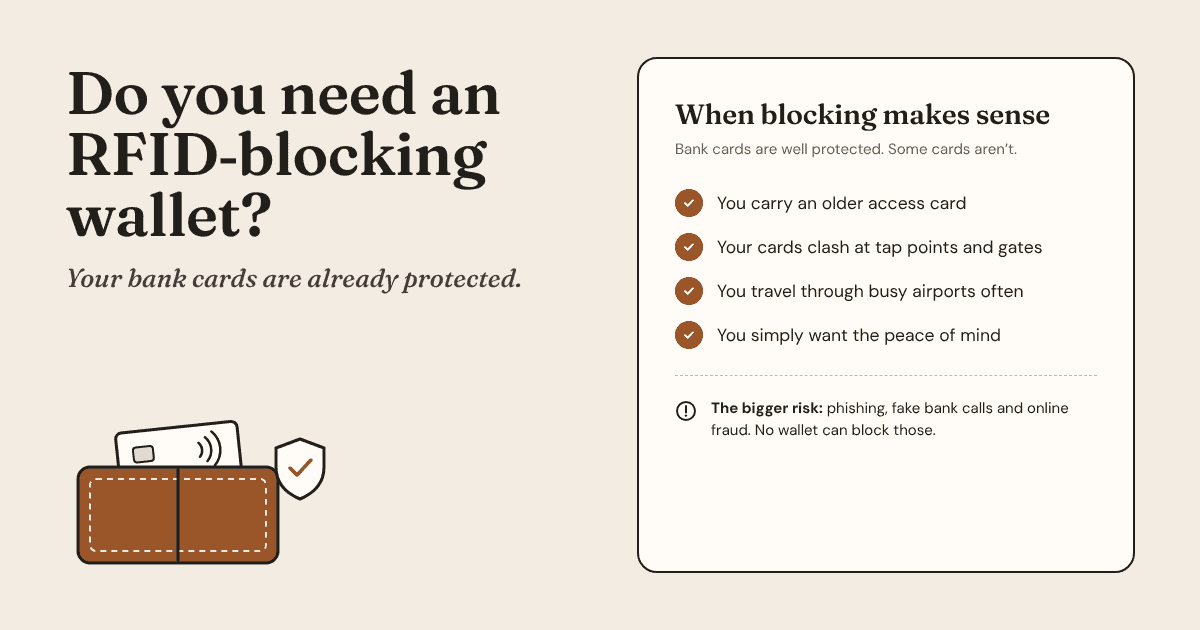
It’s not essential for most bank cards, but there are good reasons people choose one. The threat these wallets are usually sold on, someone wirelessly reading your bank card through your pocket, is rare and far less useful to criminals than it sounds. Modern contactless cards are built so that what can be read isn’t enough to clone the card or shop online.
We sell wallets for a living, and this is one of the questions we hear most. Here’s what’s actually going on, what the real risks are, and when blocking genuinely makes sense.
What RFID skimming actually is
RFID skimming means using a hidden reader to pull information off a wireless card without the owner knowing. The worry is that someone brushes past you in a queue or a taxi rank and quietly reads the card in your pocket.
Your bank card’s tap-to-pay feature uses a type of RFID called NFC (near-field communication). If your card has the little wave symbol on it, it’s contactless. When you tap it at a till, the terminal powers the chip in the card with a short burst of radio energy, and the two exchange a small packet of payment data.
That’s the same exchange a skimmer would try to copy. The question is whether what it gets is worth anything.
Why the risk is smaller than it sounds
Three things work against a would-be skimmer.
The range is tiny. Contactless cards are designed to talk over about 4 cm. Researchers have stretched that to roughly 20 to 50 cm with large, non-standard antennas, but that’s lab equipment, not something you slip into a jacket. In practice, a thief has to get a reader almost against your wallet, and other cards, your body and anything metal nearby all interfere with the signal.
The data is limited. A contactless read typically gives up the card number and expiry date, but not the CVV on the back and not your PIN. On many cards the cardholder’s name isn’t shared either. That’s less than anyone can see by glancing at the front of your card.
Each tap is a one-off. Every contactless payment uses a fresh, one-time code generated by the chip. Copying one transaction doesn’t let anyone make a working clone of your card, because the next payment needs a new code only the real chip can produce.
That’s why most security experts rate RFID skimming as a low risk. It’s technically possible, but there are far easier ways to steal card details.
What actually causes card fraud in South Africa
The numbers point somewhere else entirely. According to SABRIC’s 2025 Annual Banking Crime Statistics, card fraud losses in South Africa rose 18% to R1.7 billion, and card-not-present fraud remains one of the biggest contributors. That’s fraud where your card details are used online or over the phone, without the physical card.
In SABRIC’s 2023 report, card-not-present fraud made up 68% of gross card fraud losses. Counterfeit card fraud, the category a skimmed clone would fall into, had dropped 48% and accounted for just 2% of card fraud incidents.
So how do criminals get your details? Mostly through:
- Phishing emails, fake SMSes and calls from people pretending to be your bank
- Data breaches at online stores
- Fake or compromised checkout pages
- Stolen cards, often taken at ATMs by someone who has watched you enter your PIN
None of these involve reading your card through your pocket, and an RFID-blocking wallet does nothing to stop them.
When RFID blocking does make sense
Bank cards are well protected, but not everything in your wallet is. Blocking is worth considering if:
- You carry an older access card. Some office, gym and estate access cards use older RFID technology with little or no encryption, and these can be copied. If losing access to your building would be a real problem, shielding that card is a sensible precaution.
- Your cards clash at tap points. Two contactless cards side by side can confuse a reader, so the wrong card gets charged or the gate won’t open. A blocking layer between them sorts that out.
- You travel a lot. Crowded airports and tourist spots are where pickpockets work, and some travellers like the extra layer for passports and cards.
- It gives you peace of mind. That’s a fair reason on its own, as long as you know what it does and doesn’t protect against.
If you’re not sure whether an access card is the older, copyable kind, ask whoever issued it. And if any of the above sounds like you, our RFID-blocking wallets are worth a look.
Simple ways to protect your cards
These habits do far more for your security than any wallet lining:
- Turn on transaction notifications in your banking app, so you see every payment the moment it happens.
- Never share OTPs, PINs or card details with anyone who contacts you. Your bank will never ask for them.
- Use virtual cards for online shopping if your bank offers them. Many South African banks do, and they can be cancelled without touching your physical card.
- Cover the keypad when entering your PIN, and decline “help” from strangers at ATMs.
- Lock or freeze your card in the app the moment it goes missing, then report it.
- Carry fewer cards. Every card you leave at home is one less to lose, and one less to cancel.
So, should RFID blocking decide which wallet you buy?
Probably not. Choose a wallet for how you carry: how many cards, whether you need cash, front pocket or back. If RFID blocking comes with a wallet you already like, think of it as a bonus rather than the reason to buy.
Worth knowing: metal cardholders tend to block signals simply because of what they’re made of, which also means you’ll usually need to take a card out to tap it. Tyvek® and leather wallets don’t block anything on their own, and for most people that’s perfectly fine.
You can browse our Tyvek®, leather and metal wallets at paperslim.co.za.
Sources
- SABRIC 2025 Annual Banking Crime Statistics Report, Banking Association South Africa
- SABRIC 2023 crime statistics release, Banking Association South Africa
- Do RFID wallets actually work?, McAfee
- Contactless card fraud: myths and realities, Payments Industry Intelligence
- Report blasts holes in contactless card security claims, eWeek