
How Often Should You Replace Your Wallet? Here’s What Actually Matters 13th September 2026 – Posted in: Wallets
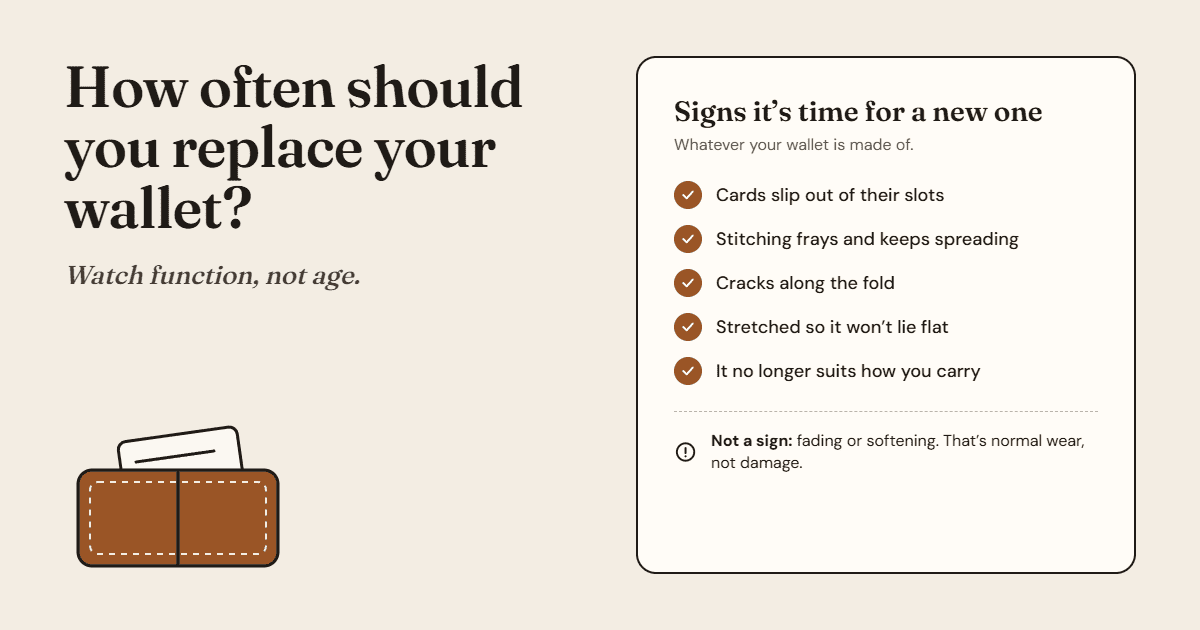
There’s no fixed rule for how often to replace a wallet. Most last anywhere from under a year to five years or more, depending on two things: what the wallet is made of and how you treat it. The best signal isn’t age. It’s whether your wallet still does its job.
We get asked this a lot, in different forms: how often to replace a wallet, how often people actually buy new ones, and whether there’s some rule everyone else knows. There isn’t, and anyone who gives you one exact number is guessing. Here’s what actually decides it.
How long does a wallet last? It depends on the material
Every material wears differently, and each has its own strengths. The ranges below depend mostly on how you carry your wallet: the lower end is for heavy daily use, such as a full wallet in a back pocket, and the higher end is for lighter use, such as a front pocket or bag with only a few cards.
Leather wallets
A decent leather wallet lasts around three years with heavy daily use, and five years or more if it’s treated gently and not overfilled. It softens and fades with use, which many people like, but it can crack along the fold if it’s kept too full.
Canvas and fabric wallets
Canvas and fabric wallets are light and flexible. Expect about a year with heavy use and closer to two with lighter use, usually before the stitching starts to give.
Faux leather and other synthetic wallets
Faux leather (usually PU or PVC), nylon and similar synthetic wallets vary a lot depending on how they’re made. Lower-quality ones can wear out in under a year of daily use.
Tyvek wallets
Tyvek is a synthetic material made from polyethylene fibres, but it behaves very differently from faux leather. It’s very light and thin, almost like paper, and resists water and tearing. Carried daily in a back pocket, expect about a year or two. In a front pocket or bag, with only a few cards, it can last three to four years.
Metal wallets
Metal wallets hold their shape and suit people who are hard on their things. The metal frame itself can last many years. The elastic bands or fittings that hold your cards usually wear out first, and on many designs they can be replaced without buying a whole new wallet.
Does how you carry your wallet matter?
Yes, as much as the material does. Someone who handles a wallet gently will get far more life from it than someone who sits on it in a back pocket eight hours a day. That habit shortens the life of any wallet, whatever it’s made of.
Signs it’s time to replace your wallet
Watch for these, rather than counting years:
- Cards slip out. Slots that used to hold cards firmly no longer do.
- Stitching is fraying. Especially if it’s spreading along a seam rather than staying put.
- Cracks along the fold. These don’t repair themselves and only get worse.
- It won’t lie flat. It’s been stretched out of shape from being overfilled for too long.
- It doesn’t suit how you live now. If you’ve gone from a wallet full of cards to two or three essentials, there’s no reason to keep carrying the bulkier version just because it still works.
What isn’t a sign
Fading, softening or a worn look is normal ageing, not damage. There’s no need to replace a wallet for that.
Buy once, buy well
How often you’re back in the market depends a lot on what you bought the first time. A poorly made wallet will need replacing on a schedule whether you like it or not, while a well-made one earns its keep for longer, whatever it’s made from. Different materials also suit different people, so it’s worth choosing based on how you actually carry and use your wallet.
Frequently asked questions
How long does a leather wallet last?
Around three years with heavy daily use, and five years or more if it’s treated gently and not overfilled.
How long does a Tyvek wallet last?
About a year or two if it’s carried daily in a back pocket, and three to four years in a front pocket or bag with only a few cards.
Should I replace my wallet if it looks faded?
No. Fading and softening are normal wear. Replace it when it stops working properly: cards slip out, seams fray, or it cracks along the fold.
Is it bad to keep your wallet in your back pocket?
It shortens a wallet’s life. Sitting on a wallet for hours a day stretches it out of shape and puts stress on the fold and seams.
The short answer
There’s no set number. Watch function, not age. If your wallet holds your cards and closes the way it should, keep using it. When it stops doing that job, it’s time for a new one.