
What is Tyvek®? 13th September 2026 – Posted in: Wallets
If you’ve landed on this page, chances are you’ve just picked up something made from Tyvek®, maybe a wallet, a wristband, or an envelope, and noticed it feels a bit like paper but clearly isn’t. That’s not a coincidence.
Tyvek® is genuinely one of the stranger, more interesting materials in everyday use, and it’s worth understanding what it actually is before we get into why we chose to sell wallets made from Tyvek®.
So what actually is it?
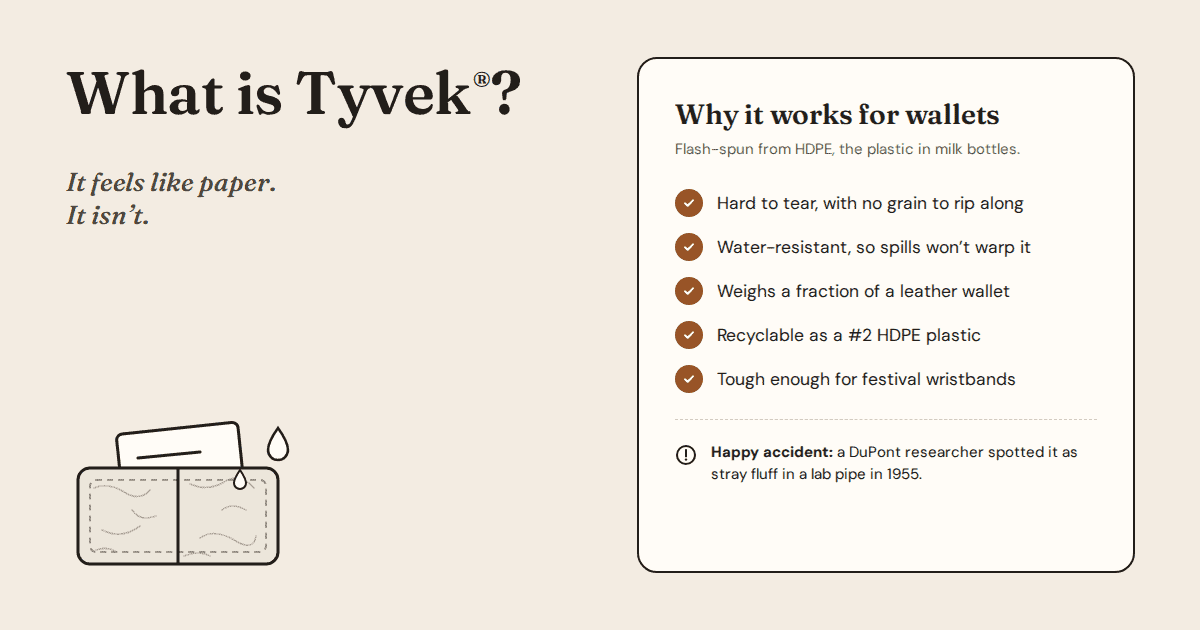
Tyvek® is a synthetic, non-woven material made from high-density polyethylene (HDPE), the same base plastic used in things like milk bottles, just processed in a completely different way. Instead of being woven like fabric or moulded like plastic, Tyvek® is made by flash-spinning fine HDPE fibres into a random web and bonding them together under heat and pressure.
What comes out the other end is a sheet that looks and feels remarkably like paper, but behaves nothing like it. It’s tear-resistant, water-resistant, and far tougher than its weight would suggest, which is exactly why it’s ended up in such an odd range of places, from hospital packaging to festival wristbands to the wallet in your pocket.
Tyvek® is a registered trademark of DuPont de Nemours, Inc., and it isn’t something you’ll find made by anyone else under that name. Other companies have their own similar spunbonded materials, but Tyvek® specifically is DuPont’s.
Where it came from
Tyvek® wasn’t invented on purpose, at least not at first. In 1955, a DuPont researcher named Jim White noticed a strange white polyethylene “fluff” coming out of a pipe in one of the company’s experimental labs. Instead of writing it off, White and the DuPont team spent the next several years figuring out what the material actually was and how to turn it into something usable.
It took until 1959 to produce the first proper sheets, and DuPont didn’t trademark the Tyvek® name until 1965, finally bringing it to commercial market in 1967.
The first serious use for it wasn’t fashion or wallets at all. It started out as a waterproof book cover material, then moved into home construction in the 1970s as a weather barrier wrap, and by the early 1970s DuPont had also found a home for it in medical packaging, where its ability to block microbes while still allowing sterilisation made it genuinely valuable.
From there it slowly worked its way into design and lifestyle products, where its odd paper-like texture and durability started to appeal to people making bags, wallets, and accessories rather than just building wrap.
A couple of things you probably didn’t know about it
Tyvek®’s durability and light weight have made it useful in some unexpected places over the years. It’s the material behind most of the wristbands used at outdoor festivals and live music events, chosen because it’s tough enough to survive a weekend outdoors but still tears cleanly if someone tries to remove it and pass it on.
A handful of countries, including Costa Rica, the Isle of Man, and Haiti, have even printed banknotes on Tyvek® in the past, although none of those notes are still in circulation today
Why it works so well for wallets
None of this would matter much if Tyvek® weren’t actually good to carry around every day, but it holds up well against the two things that wreck most wallets over time: physical wear and moisture.
It’s genuinely hard to tear. The random fibre structure means there’s no clear grain running through the material, so it resists ripping in a way that woven fabrics and even some leathers can’t match. It’s also naturally water-resistant, so a bit of rain or a spilled drink isn’t going to warp it or leave it damp for days the way a fabric wallet might.
It’s recyclable too. Tyvek® is classified as a #2 HDPE plastic, which puts it in one of the more widely recyclable plastic categories, a small but genuine point in its favour compared to some other wallet materials.
And then there’s the obvious bit: it’s light. A Tyvek® wallet weighs a fraction of what a leather one does, which is a big part of why it’s become the material of choice for people trying to carry less bulk without giving up durability.
Where Tyvek® fits into our range
We carry Tyvek® wallets alongside our leather and metal options because it genuinely suits a different kind of carry. If you want something ultra-light, water-resistant, and nearly impossible to tear, Tyvek® is hard to beat. If you’re after something that develops character over the years, leather is still the better call, and if you want maximum durability in a hard shell, metal has its place too.
You can see our full range of Tyvek®, leather, and metal wallets at paperslim.co.za.