
When Was the Wallet Invented? A Brief History of Carrying Your Cash 9th September 2026 – Posted in: Wallets
Five thousand years ago, a man crossing the Alps carried a small leather pouch on his belt, holding a flint dagger and a fire-starting kit. He’s the reason the answer to ‘when was the wallet invented?’ is more complicated than you’d think.
People have been carrying pouches of some kind for thousands of years, long before anyone had a card to slide into a slot, and long before ‘wallet’ even meant what it means today.
We sell wallets for a living, so naturally we got curious about where the whole idea came from. Here’s what we found.
Long before money existed
The earliest thing you could call a wallet wasn’t really a wallet. It was a pouch, usually leather, worn at the hip or tied to a belt. Archaeologists have found examples going back to prehistoric times, used for carrying tools, food, and small valuables rather than cash.
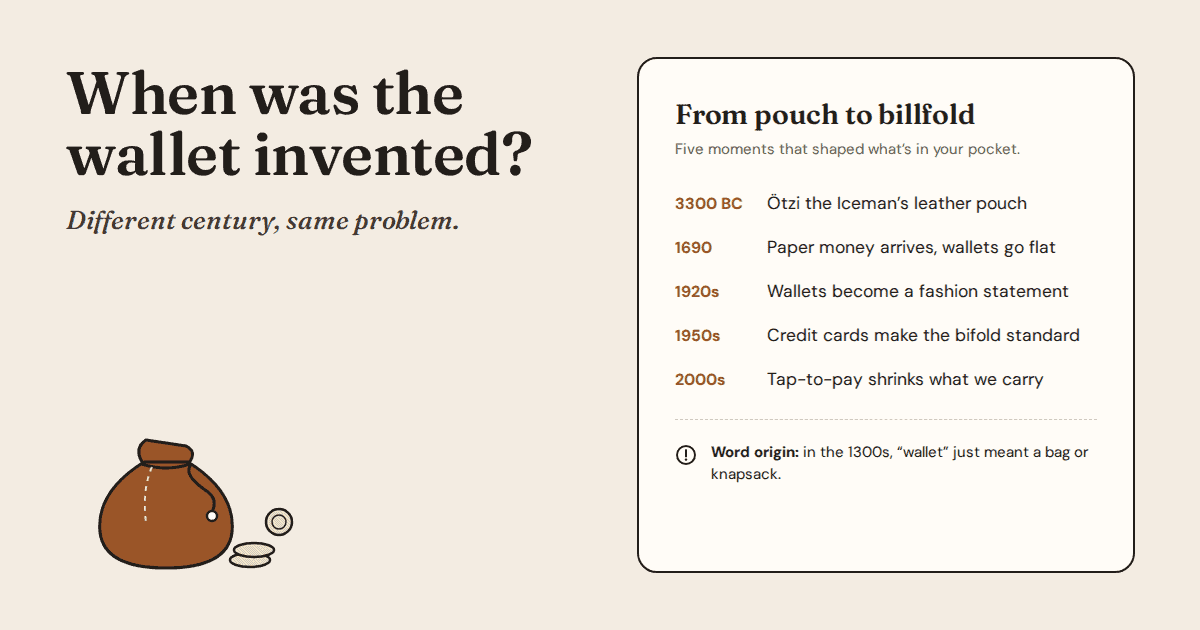
One of the more famous finds is Ötzi the Iceman, a mummified body from around 3,300 BC, discovered with a small leather pouch containing a flint dagger and fire-starting kit. Not exactly a bifold, but the idea is there.
The Ancient Greeks had something similar, a small carrying pouch they called a “knapsack,” used to hold a day’s food and provisions while working or travelling.
So, if you’re asking when wallets were made in the loosest sense, the answer is: thousands of years before anyone needed to carry money at all.
When wallets actually started looking like wallets
The word “wallet” shows up in English as early as the late 1300s, though back then it just meant a bag or knapsack. By the early 1600s it was common enough that Shakespeare used it in Troilus and Cressida.
But the version we’d actually recognise today, flat, foldable, made for holding cash, came later. The real shift happened in 1690, when the Massachusetts Bay Colony issued the first paper currency in the Western world.
Before that, people carried coins in small drawstring purses. Coins are bulky. Paper isn’t. Once paper money existed, there was suddenly a reason to make something flatter and more compact, and that’s roughly when the modern wallet was born.
These early “billfolds” were made from cow or horse leather and mostly carried by merchants and the upper classes. They weren’t just for money either. They had a slot for calling cards, an early form of identification used by the elite. Owning one was as much about status as it was about function.
How it kept changing from there
From that point, the wallet kept getting reinvented as needs and materials changed:
- 17th to 19th centuries – wallets shrank and became easier to carry as everyday life moved away from bags worn at the waist.
- 1920s – fashion houses started treating wallets as style statements, not just functional objects.
- 1950s – credit cards arrived, and wallets needed dedicated slots. This is where the classic bifold became the default shape most people still picture.
- 1970s to 1990s – new closures and materials showed up, Velcro included, along with a wider range of leathers and fabrics.
- 2000s onward – tap-to-pay and digital wallets started reducing how much people actually needed to carry, which opened the door for slimmer designs.
Which brings us to now
There’s something almost funny about it: the wallet was invented to solve a bulk problem, trading heavy coin purses for something flatter.
Three hundred years later, we’re solving the same problem again, just with a different kind of bulk.
Most people today carry a handful of cards, maybe some cash, and not much else. Loyalty cards nobody scans, receipts nobody reads, a wallet twice the size it needs to be. Minimalist wallets exist for the same reason the original billfold did: carry what you actually use and skip the rest.
That’s really the whole idea behind PaperSlim. Different century, same problem, and we’ve curated a range of wallets built for how people actually carry things now, from lightweight Tyvek to metal and leather.
If you’re curious what that looks like in practice, you can browse our wallets on paperslim.co.za.