
Types of Wallets: What Each One Is Good For (and What It Isn’t) 6th October 2026 – Posted in: Wallets
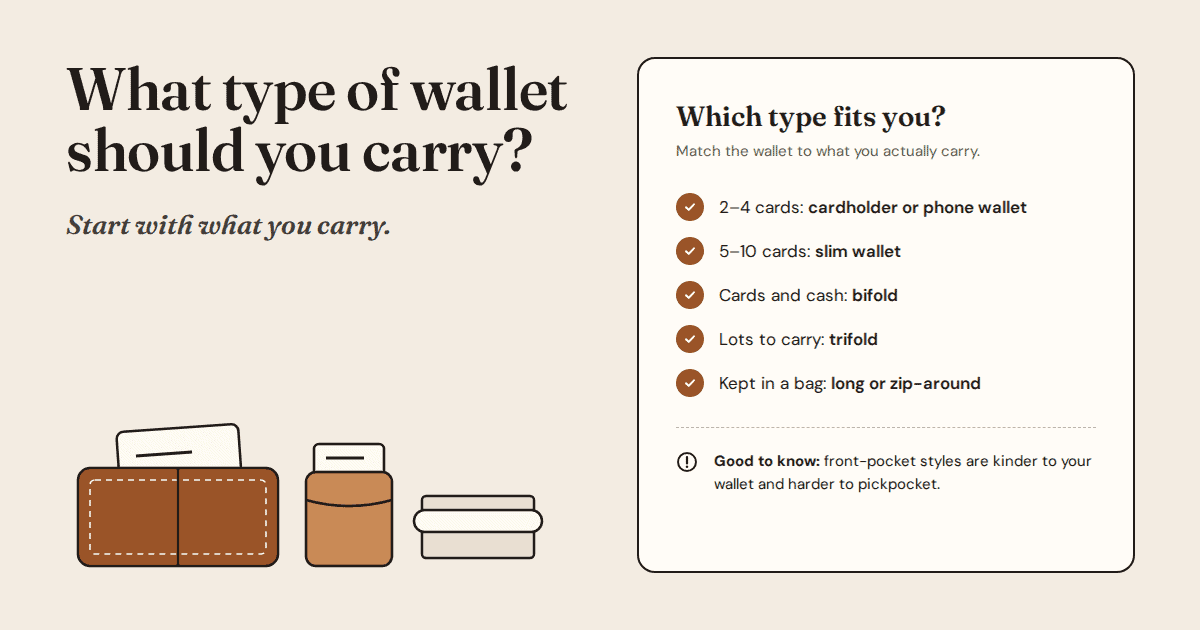
There are around ten common types of wallet, from the classic bifold to cardholders, money clips and phone wallets. None of them is the “best” one. The right type depends on what you carry, where you carry it, and how much bulk you’re willing to put up with.
We sell wallets, so we hear this question a lot, usually phrased as “what kind of wallet should I get?” The honest answer is that most people pick a type out of habit, not because it suits how they actually live. Here’s a plain rundown of each type, what it’s good at, and where it falls short.
The main types of wallets
Bifold wallets
The bifold is the wallet most people picture: a rectangle that folds once down the middle, with card slots on either side and a full-length cash pocket. It’s popular for good reason. It holds a fair amount without being huge, and it fits most pockets.
The downside is that it invites overfilling. Because there’s always room for one more card or receipt, many bifolds end up thick, stretched and uncomfortable to sit on.
Best for: people who carry a mix of cards and cash and want a familiar, all-round option.
Trifold wallets
A trifold folds into thirds, which gives it more slots and pockets than a bifold. It used to be very common, especially for people who carried lots of cash, cards and paperwork.
That extra capacity comes at a cost. A full trifold is one of the thickest wallets you can carry, and the extra folds mean more stress points that wear over time.
Best for: people who genuinely need to carry a lot and don’t mind the bulk.
Slim and minimalist wallets
Slim wallets are built around carrying less. They usually hold somewhere between four and ten cards, with a little room for folded notes. The idea is to carry only what you use, rather than everything you own.
The trade-off is obvious: if you carry lots of loyalty cards, receipts or coins, a slim wallet will feel cramped. But for many people, moving to one is a useful prompt to clear out cards they haven’t used in months.
Best for: people who mostly pay by card and want something that barely registers in a pocket.
Cardholders
A cardholder is the most stripped-back option: a few slots, sometimes a central pocket, and that’s it. Some hold folded cash, many don’t.
They’re excellent as a front-pocket carry or as a second wallet for evenings out. They’re less practical if you still regularly use cash.
Best for: card-only carriers and anyone who wants the smallest possible option.
Money clips
A money clip is a sprung metal or magnetic clip that holds folded notes, sometimes with a few cards. Some wallets combine a clip with card slots.
They’re slim and quick to use, but they leave your cash exposed, and they don’t hold coins at all. Cards can also slip out if the clip loosens with age.
Best for: people who carry a small amount of cash and a couple of cards, and like a quick, simple carry.
Front-pocket wallets
Front-pocket wallets are designed to be thin and narrow enough to sit comfortably in a front trouser pocket. Many slim wallets and cardholders fall into this category.
Carrying in a front pocket is more comfortable when sitting, harder for pickpockets to reach, and kinder to the wallet itself. As we covered in our post on how often you should replace your wallet, sitting on a wallet all day is one of the fastest ways to wear it out.
Best for: anyone who spends a lot of time sitting, driving or in busy public places.
Long wallets (continental wallets)
Long wallets are tall enough to hold notes flat, without folding them. They often have plenty of card slots, a coin section and sometimes space for a phone. They’re usually carried in a bag, a jacket’s inside pocket or by hand.
They’re very organised, but far too big for most trouser pockets.
Best for: people who carry a bag and want everything in one place.
Zip-around wallets
A zip-around wallet closes fully with a zip on three sides. It’s a common style for long wallets and purses, but smaller versions exist too.
The zip keeps coins, cards and receipts from falling out, which is its main strength. The zip is also usually the first thing to fail.
Best for: people who carry coins and small items and want everything secured.
Phone wallets
Phone wallets come in two main styles: a phone case with card slots built in, or a small card sleeve that sticks or clips to the back of your phone.
They mean one less thing to carry, but they also mean that if you lose your phone, you’ve lost your cards too. Most hold only two or three cards.
Best for: people who already carry very little and want their phone and cards together.
Travel wallets
Travel wallets are larger organisers built to hold a passport, boarding passes, foreign currency and cards in one place. Some are worn under clothing for security.
They’re great for trips, but not something you’d carry every day.
Best for: travellers who want their documents organised and in one place.
Does the material change the type?
Not really, but it changes how a type behaves. A bifold in thick leather and a bifold in thin fabric are the same style, yet one will be noticeably bulkier and wear very differently.
Leather is the traditional choice and ages well, though it adds thickness. Canvas and nylon are light and casual. Metal suits cardholders and money clips, and holds its shape. Tyvek®, the material our wallets are made from, is unusual: it’s thin and light like paper, but resists water and tearing. That makes it well suited to slim, front-pocket designs. If you’re curious about it, we’ve written a full post on what Tyvek® is.
So when choosing, think about the type first, then the material that makes that type work best for you.
How to choose the right type of wallet
Start with what you actually carry, not what you might carry. Empty your current wallet and sort it into what you’ve used in the past month and what you haven’t. Most people are surprised by how little makes the first pile.
Then ask yourself a few questions:
- How many cards do you use regularly? Two to four points to a cardholder or phone wallet. Five to ten suits a slim wallet. More than that, a bifold.
- How much cash do you carry? If you rarely use notes, you don’t need a full-length cash pocket. If you use coins often, look at a zip-around or a wallet with a coin pouch.
- Where will you keep it? Front pocket means slim and narrow. Back pocket works for a bifold, but it’s harder on the wallet. A bag opens up long and zip-around styles.
- What does your day look like? Lots of sitting, driving or busy public spaces all favour something thin you can carry in a front pocket.
It’s also fine to own more than one. Plenty of people use a bifold for everyday and a cardholder for evenings out or the gym.
Frequently asked questions
What is the most common type of wallet?
The bifold. It’s the default for most people because it balances capacity and size, and it fits most pockets.
What’s the difference between a slim wallet and a cardholder?
A slim wallet usually holds more cards and has room for folded cash. A cardholder is even more minimal, often just a few slots, and may not hold cash at all.
Which type of wallet is best for a front pocket?
Slim wallets, cardholders and money clips. Anything thin and narrow enough that it doesn’t create a noticeable bulge or dig in when you sit.
Is a trifold or bifold better?
A bifold suits most people. A trifold only makes sense if you need the extra capacity, because it’s noticeably thicker when full.
Do I need a wallet with a coin pocket?
Only if you regularly use coins. Many people who pay mostly by card find a coin pocket just collects loose change they never spend.
The short answer
There’s no single best type of wallet. Bifolds suit most people, slim wallets and cardholders suit those who carry less, and long or zip-around wallets suit people who keep theirs in a bag. Choose based on what you actually carry and where you carry it, and the right type usually becomes obvious.